
All over print across panels and seams
We print the flat roll before the garment is cut. That means ink runs under the stitch lines, but it also means the artwork splits across the shoulder, the side seam and the front buttons. Here is what to expect when a picture becomes a shirt.
How the panels meet on the bench
We hold 40 pieces in button-down and hawaiian shirts. The method is straightforward. We lay your artwork across wide yardage, print the cloth while it is flat, and cut the front panels, back yoke, sleeves and collar out of the printed run. The pieces then get sewn together. Because the parts are cut separately, the design steps slightly across every join. The left front panel does not align row for row with the right front panel down the front closure. The sleeve head does not line up with the shoulder yoke. That is normal construction for cut and sewn garments.
Why repeat patterns handle the joins
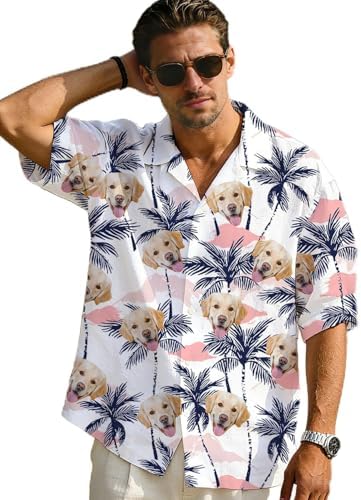
A repeat pattern handles seams because it expects interruption. If a small motif of a dog head gets cut in half under an armpit seam, the eye barely registers the break. The next motif sits two handbreadths away, intact and clear. A single large photograph does not have that luxury. If you stretch one family photo across the entire chest, the buttons split the image down the center, and the button placket swallows parts of the frame. Repeat layouts scatter the element so that loss at the edges does not destroy the composition. The shirt works as a pattern, not a poster.
What happens when you send a face
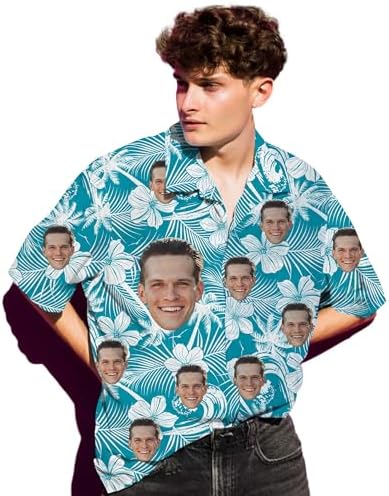
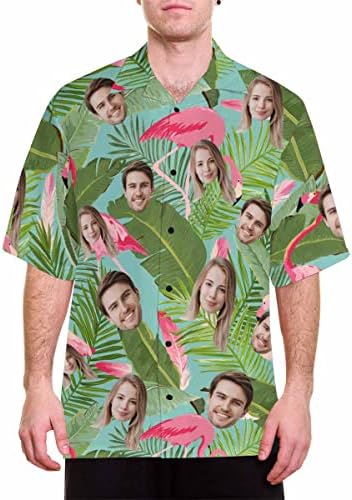
When you upload a portrait for an all over shirt, we crop the head from the original background and duplicate it. We scatter the face across the cloth as a tiled motif. That is a fundamentally different look than a single centered portrait on a basic tee. Some faces will sit near the collar. Others will land across a pocket or get caught in the hem stitch at the waist. A clean, forward-facing headshot with clear light makes the sharpest repeating unit. If the lighting on the face is muddy or the top of the hair is clipped in the upload, that flaw repeats everywhere.
The placket and the collar fold
The front closure shows the seam split most clearly. The button placket folds the cloth over to take the buttons and buttonholes, which takes a strip of the design out of view. When the shirt is buttoned up, the left side overlaps the right side, shifting the pattern horizontally. The collar introduces a second shift because the fabric folds back on itself at the neck. If you look closely at the lapel, the pattern is upside down relative to the chest beneath it until the collar lies flat. We let the layout flow through these mechanical steps rather than trying to force alignment.
The same rule on swim shorts
The same logic applies to swim shorts and other cut pieces in our range. Shorts use four main panels plus a waistband and pockets. The outer leg seam splits the design from hip to hem, and the gathering along an elastic waistband bunches the artwork into tight folds. A scattered element handles the gather without distortion. A straight line of text or a wide horizontal logo gets twisted by the elastic channels. Choosing a repeating design keeps the garment readable while wet, stretched, or hanging dry on a line. The pattern survives the cut because it was built for it.
Short version
- Our catalogue holds 552 pieces across 14 sections organized by printable surface.
- We hold 40 pieces in button-down and hawaiian shirts.
- Yardage is printed flat before garment panels are cut and sewn together.
- Button plackets overlap when fastened and shift the artwork pattern out of alignment.
- Collars fold the printed cloth over at the neck to create the lapel.
Preparing an image for garment panels
Send a portrait with clear edges and balanced light. We isolate the subject and tile it across the cloth before cutting. The seams will split the repeats at the sides, buttons and collar, but the overall pattern holds together cleanly across the whole garment.
From this section
Pieces this note is about
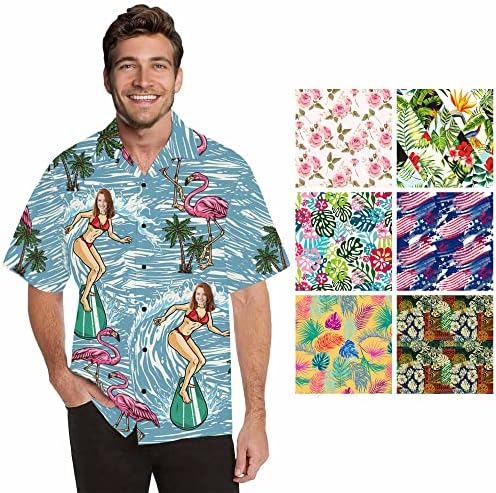
Hawaiian & Button-Down holds 26 pieces. These four get ordered most.
Keep reading
Other notes from the bench
Bench notes
Why the surface decides the print
We sort our catalogue by the material we print on, because cloth, metal, and acrylic treat a photograph differently.
Artwork notesCropping a face for the bench
Personalisation is ink on a surface, not sorcery.
Outdoor notesPrinting outdoor pieces for the yard
Outdoor printing has to work against sunlight, rain and distance.